Kitefoil Lessons and Courses

Take off with Kitefoil

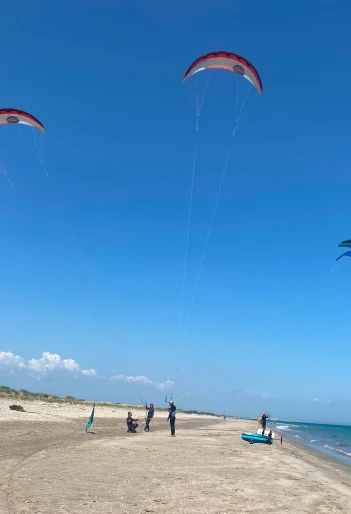
Kitefoil Course Overview
Course Content
- Foil theory: A bit of theory to understand how the foil works and learn the technical terms. We’ll briefly talk about the front wing, stabilizer, fuselage, mast, roll, pitch, and yaw. Don’t worry—our priority is to get you riding as much as possible!
- Handling and controlling the board: Learn how to handle the foil and avoid common mistakes. Heavier and bulkier than other kite boards, the foil requires proper technique to position it safely.
- Waterstart: Learn how to control and position the foil board to get your feet in easily and avoid potential mast impacts.
- Learning to ride flat without take-off: Master foil board control while riding with the foil in the water. If conditions allow, we may offer a towed foil session behind a motorboat. Without the kite, you can fully focus on board control and experience your first flights.
- First flights: Experience your first flights above the water! Learn correct body positioning to maintain balance once the foil lifts.
- Maneuvers: Once hooked on the unique sensations of foiling, you’ll want more. Next steps include transitions, air jibe, air tack, 360°, and more.
Learning Kitefoil
- Have good kite control;
- Be comfortable flying the kite in light wind;
- Be able to control the kite one-handed in all wind conditions.
Comparison with Kitesurf
What’s different ?
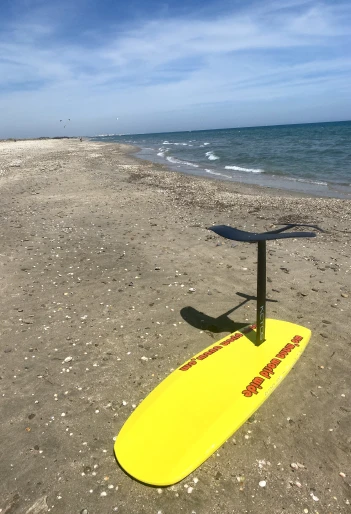
Your board is equipped with a mast and what’s known as an “aircraft.”
When learning and handling the foil, it’s easy to forget all that hardware under the water—watch out for shin hits or foot cuts!
While a twintip is light and easy to handle, a foil board is bulkier.
Knowing the correct technique to position the foil for the waterstart makes a big difference.
You’ll also need to adapt to a slightly different riding dynamic—especially foot pressure.
On a twintip, more weight is on the back foot. With a foil, it’s the opposite!
Start by putting weight on the front foot, then gradually rebalance between both feet.
For a comfortable stance (balanced weight distribution), proper foil setup is essential.
What stays the same
Foiling is at least as magical as riding a twintip or surfkite. It’s absolutely worth the effort—once you experience your first flight, you’ll want to keep foiling forever!
It’s not called the Magic Carpet for nothing.
Kite control works the same regardless of the board—but light-wind kite skills become even more important.
Mastering the downloop for maneuvers is a big plus!

Lesson Duration

Available Packages
Kitefoil Lesson
Private or two-person lesson combining personalized coaching, guided riding, and a theoretical debrief—discover a unique board sport.
Towed Kitefoil
Towed kitefoil (or kitefoil simulator) is an excellent teaching tool to discover foil gliding sensations.
Adults / Youth:
If you are between 13 and 75 years old and ride independently in kitesurfing.
If you’re frustrated by light wind conditions.
Or if you simply want to expand your playground and enjoy long rides—
If that sounds like you, sign up for a kitefoil lesson and join the lightwind riders movement!

Kitefoil
ALL LEVELS
Kitefoil Lesson
190 €
Frequently
Asked
Questions.
What is kitefoil and how does it work ?
A kitefoil board looks like a surfboard equipped with a mast and a structure called a foil, made up of a fuselage, a front wing, and a stabilizer.
Thanks to speed and lift generated by the front wing, the board lifts off the water’s surface. The stabilizer ensures stable and controlled flight.
The result : a unique, smooth, and silent gliding sensation above the water.
How are kitefoil lessons structured at Monki School ?
We first gear up at the center, then head by motorboat to the spot best suited to the day’s weather conditions.
Once there, equipment preparation (kites and boards) takes place on the beach, followed by a briefing before entering the water.
Learning kitefoil can be destabilizing at first : it often requires relearning body dragging, waterstart, and riding.
Exercises are adapted to each student’s pace. Be patient with yourself : flying above the water on a foil is simply a magical experience.
Where do kitefoil lessons take place around Montpellier ?
Lessons take place in the Bay of Aigues-Mortes, between Frontignan and Espiguette Beach.
The exact spot is chosen according to the weather conditions to ensure safety and optimal learning.
What equipment is required to learn kitefoil with Monki ?
To take part in a kitefoil lesson, you simply need to bring :
- Swimsuit
- Towel
- Sunscreen
- Sunglasses
The Monki school provides all kitefoil equipment.
Outside the summer season, in cold weather, we recommend bringing neoprene booties. In summer, don’t forget beach shoes.
What are the prerequisites for registering for kitefoil lessons ?
A good level of kite control greatly facilitates learning kitefoil.
If you already ride a surfboard or a directional board (such as a Tiki), and are comfortable with foot changes, progression will be faster.
It is also possible to take a efoil lesson before starting kitefoil.
However, even without these prerequisites, it is still possible to start kitefoiling : it will simply require a bit more time.
How can I register for kitefoil lessons and courses at Monki School ?
Go to our website, click on the “Book” button at the top right, and follow the instructions.
If you still have questions, feel free to contact us by email or phone.
